
In this video, I get a Speech Plus Prose 2000 Speech Synthesizer up and running.
Background
As anyone who visits this website is well aware, I collect, restore, and design vintage speech synthesizers. My go-to is usually the SP0256A-AL2 or the Votrax SC-01, but I’ve also had some fun with TMS5220 and DECtalk over the years. An eBay auction came up for a rare Speech Plus Prose 2000 and I snatched it up, so I could try this one out too. The card is pictured below:
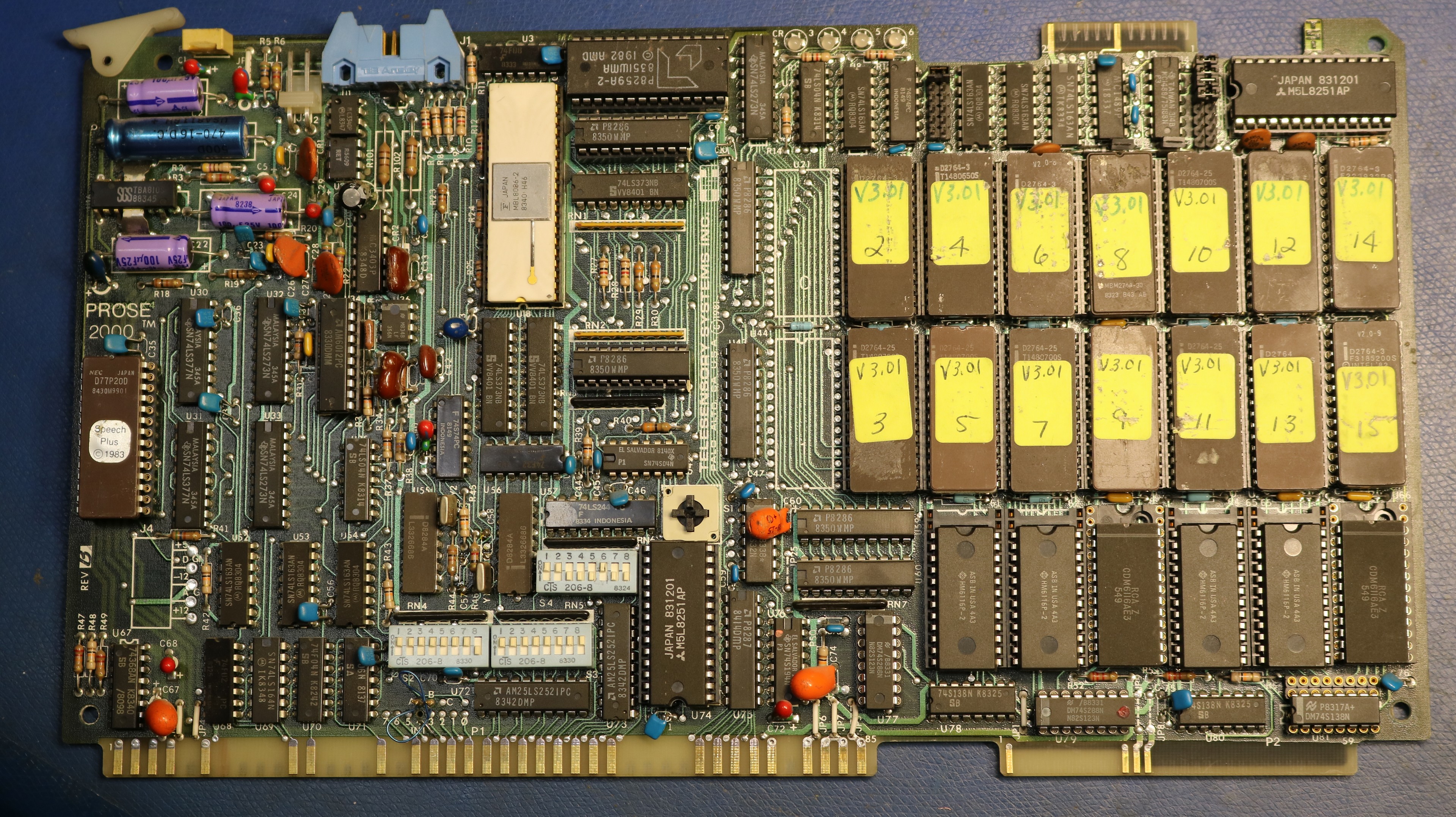
A few things we can see from this board:
- A total of 14 ROMs, each of them is a 2764.
- The microprocessor is an Intel 8086, and a white ceramic one, at that!
- Two UARTs (I’ll explain this below).
- A total of seven 6116 static RAM chips.
- One D77P20D digital signal processor
- Two connectors at the top. The blue one I believe is for front panel components (volume, status LED, etc) and the edge card connector is for a serial port.
The Stephen Hawking Connection
Stephen Hawking was diagnosed with ALS (motor neurone disease) in 1963, and over the following decades it progressively robbed him of voluntary muscle control. He could still speak — slurred, and increasingly only through an interpreter — until 1985, when he contracted pneumonia during a visit to CERN. The infection was severe enough that doctors performed a tracheotomy to save his life, and that procedure removed what remained of his natural speech. From that point on he had no voice at all, which is what put him in the market for a hardware speech synthesizer in the first place.
The first machine he used is the one worth dwelling on here: the Speech Plus Prose 2000. Walt Woltosz of Words Plus supplied him with the Equalizer selection software and a Speech Plus card in late 1985, and David Mason adapted the desktop unit into a portable system mounted on his wheelchair. The Prose 2000 was a high-quality, unlimited-vocabulary text-to-speech system on a single printed circuit board — and crucially, its synthesis engine descended from Dennis Klatt’s KlattTalk/MITalk work. That’s the same Klatt lineage DEC licensed for DECtalk, which is why Hawking’s voice is almost universally (and slightly inaccurately) called “the DECtalk voice.” It wasn’t a DEC box at all; it was Speech Plus hardware running a sibling implementation of the same engine, producing the “Perfect Paul” voice based on Klatt’s own speech.
From there the lineage stayed within the Speech Plus family rather than jumping to DEC. Hawking soon moved to the CallText 5010, a refined descendant of the same hardware, and then famously refused to ever change it — the version he relied on was last updated in 1986, and he kept it for roughly thirty years despite endless newer and more natural-sounding options. By 2014 the aging boards were wearing out, with only a couple of working units left, so engineers reverse-engineered the CallText’s processor and DSP to build a bit-perfect software emulator and preserve the voice for good. Across every generation — Prose 2000, CallText 5010, and finally the software emulation — it was the same Klatt-derived voice, which is exactly why that flat, slightly robotic Perfect Paul became inseparable from Hawking himself.
Getting the board up and running
The Speech Plus Prose 2000 is a Multibus board that can be used in a standalone (non-Multibus) configuration. As received to me, it was configured for use in a Multibus system. The key is the block of 8 jumpers up next to the card edge connector on the top right of the board. These allow you to decide whether the bus can be used via serial port, or via the Multibus interface:
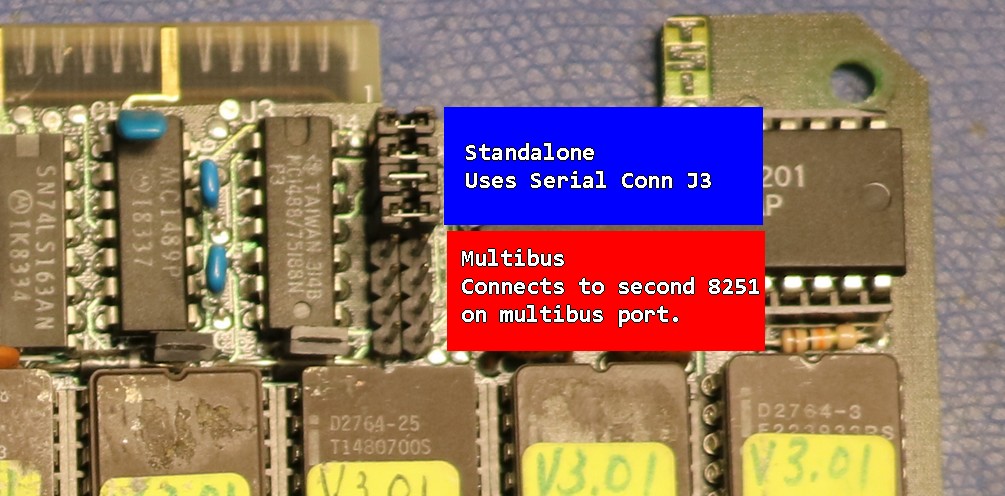
When in the lower position, the J3 serial connector and the 1488/1489 drivers appear to be unused. The serial IO is routed to a second 8251 at the bottom of the board, which has a couple jumper blocks that presumably allow you to set the IO port address on the Multibus interface. It would seem, then, your application would simply use this second 8251 UART as if it were a serial port.
To the left of the bus selection header block is a second header block (JP10) that selects baud rate. You can choose between 300, 600, 1200, 2400, 4800, or 9600 baud. As far as I can tell the Speech Plus Prose 2000 has not emitted any text on the serial interface, but it responds to text.
To make it talk, configure the bus jumpers for external serial interface (all four jumpers in the top block), then connect a serial terminal. It will not echo any text, but it will respond to what you are typing. It generally does not speak until it hits a punctuation mark, so make sure to include a period or a question mark or similar.
Dip Switches
There are a couple dip switch blocks at the bottom of the board. Here is the original configuration:
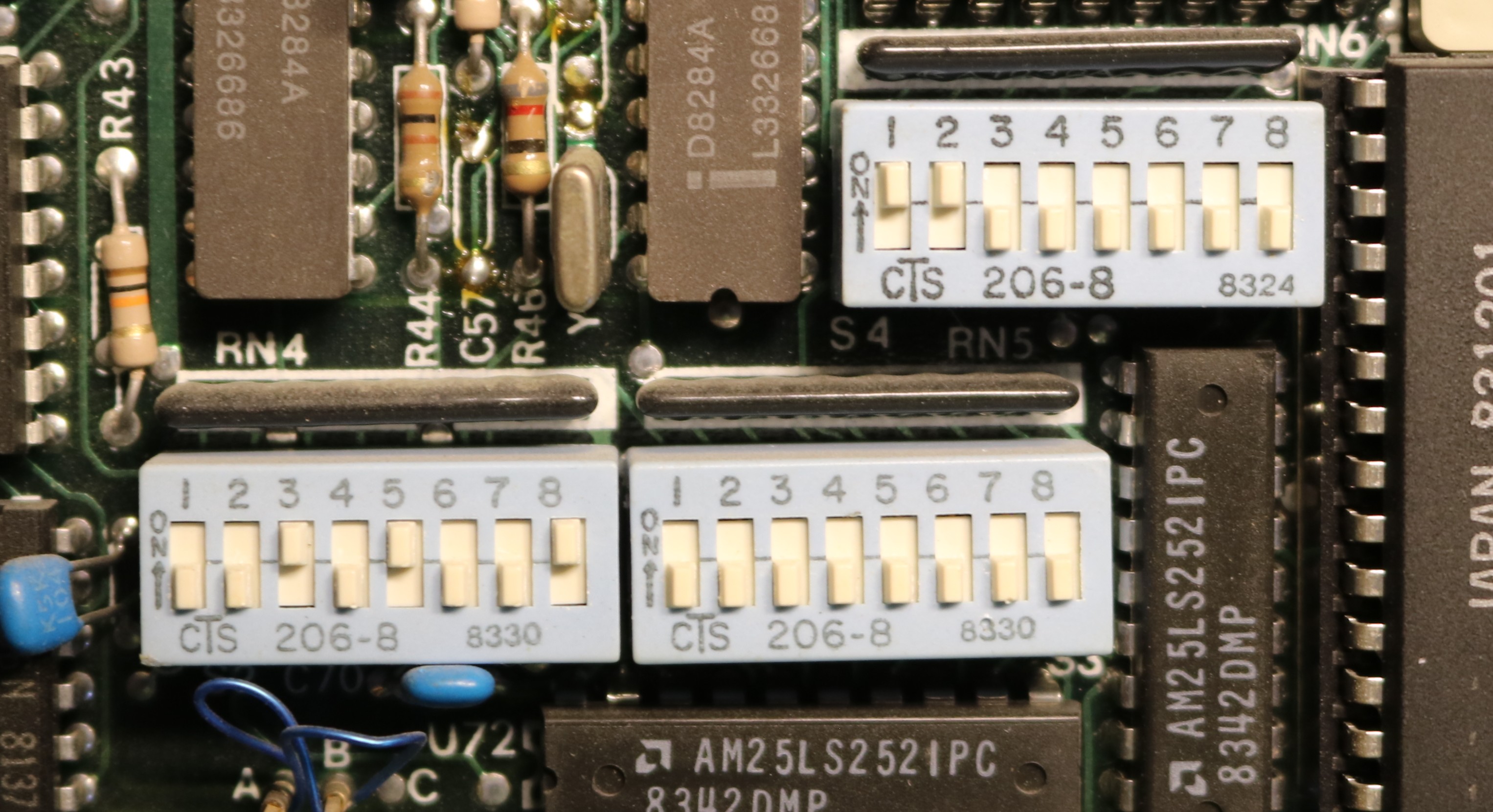
… and here is the configuration after I modified them to use the same settings as the standalone Speech Plus Prose 2000 pictured on the Vintage Computer Federation online forum:
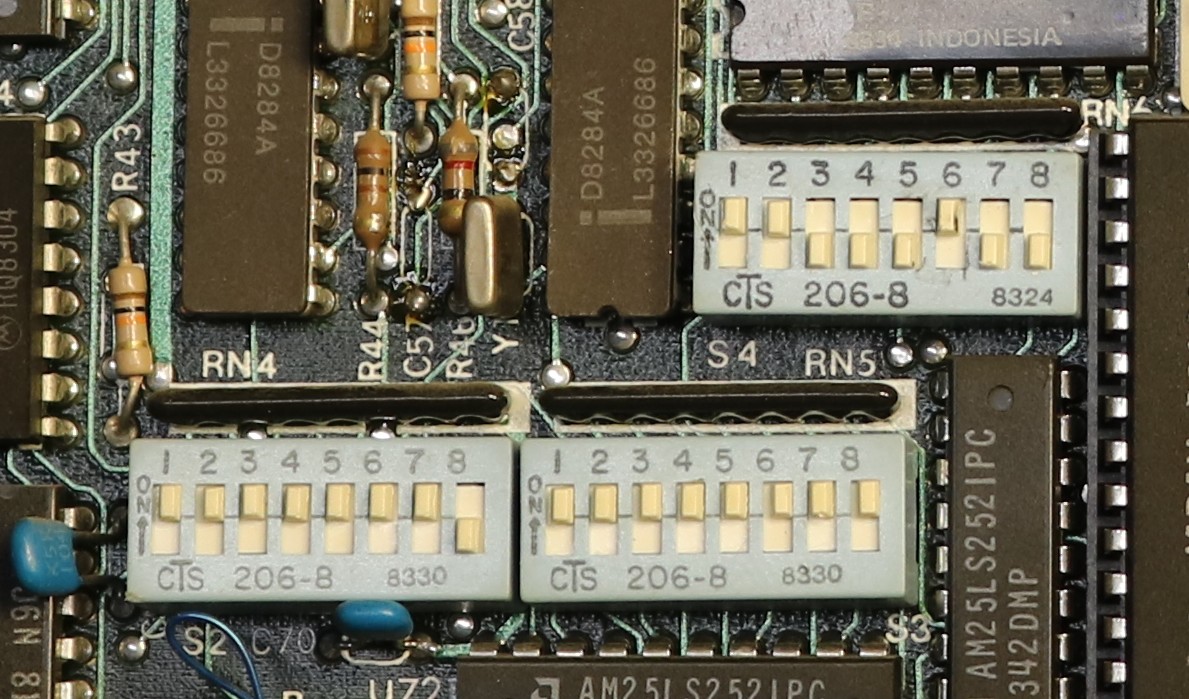
My best guess is that the two at the bottom, S2 and S3, are the Multibus address select. They are connected to a pair of AM25LS2521PC identity comparators, which are likely connected to the address lines of the Multibus. My working assumption is that these select a 16-bit address at which the UART is located. It might need a little more digging to be sure (an 8251 typically uses a pair of IO ports, which would make for a 15-bit address, not 16, so there may be one extra switch that does something else).
The block above it, S4, is connected to a 74LS244, and is presumably read by the onboard 8086 microprocessor. I was not able to determine the functions of all the switches, nor why switch S6 seemed to be different between my original configuration and the one I saw on VCFED. I did find that switching S4-7 to “on” will cause the speech synthesizer to continually loop speaking a test phrase, and that might be a good way for people to verify the overall functionality of their speech synthesizer.
Help needed
If you have a technical manual for the Speech Plus Prose 2000, or any documentation whatsoever, it would be very handy!
